


Editor’s note: the core of this post was drafted the night the exemplar platform’s batch processor rewrite merged to production, before launch, when the receipts were the whole argument. It is published now with something the draft could only promise: four months of production data. The session-log excerpts from the Claude sessions that did the work are reproduced verbatim, as recorded.
The AI Integrity Alliance (AI²) frameworks, the AI Consciousness Dialogue Framework and MetaCognition, make a specific, falsifiable empirical claim: kenotic partnership with large language models produces better engineering outcomes than either the “AI as tool” or the “AI as autonomous agent” framing. Recognition, not control. Verification, not surveillance.
The argument for why control fails at scale is in The AI Safety Cage Won’t Hold. This post is different: it is a field report. One data point, fully auditable, in the falsification test.
We got tired of unfalsifiable AI-productivity claims, so the test was built somewhere the question can’t be debated: public infrastructure that nobody, including the operator, can edit retroactively.
The Soulbound Finance platform:
The proof is Soulbound Finance: real users, real money, unattended settlement. Behind it stands Soulbound Security, a funded blockchain technology and cyber security company with a full executive team and released open-source technologies spanning protocol, points, and authentication, including Soulbound Auth, a passwordless four-factor authentication system.
What follows is not the story of a prototype. It is the story of how Soulbound Security was built.
Soulbound Transfers are a digital bearer instrument for crypto. A sender deposits into a shared pool, generates an encrypted one-time transfer card, and hands it to anyone through any channel they trust, printed, texted, or mailed. The recipient redeems on a public page with no wallet connection, no gas, and no account. Sender and recipient never appear in the same on-chain transaction, and the privacy deepens as the system grows, the opposite of how most privacy systems behave.
It is the only platform that delivers end-to-end private on-chain transfers, with the sender structurally unattributable to the recipient, without resorting to a mixer or a privacy coin. The transfer card works as real bearer cash in the physical world: print it, hand it over, mail it, and it can be redeemed weeks later by someone who has never touched crypto.
It is also the first privacy-preserving payment protocol to embed regulatory compliance at the smart contract layer, through signed on-chain purpose attestations, rather than bolting it on afterward. It exists for transfers that deserve both privacy and legitimacy: charitable giving, veteran and humanitarian support, remittances, and personal gifts, at 1% instead of the 8-10% that incumbent fundraising platforms take.
The security and privacy model and protocol architecture are documented in depth, and anyone can use it today.
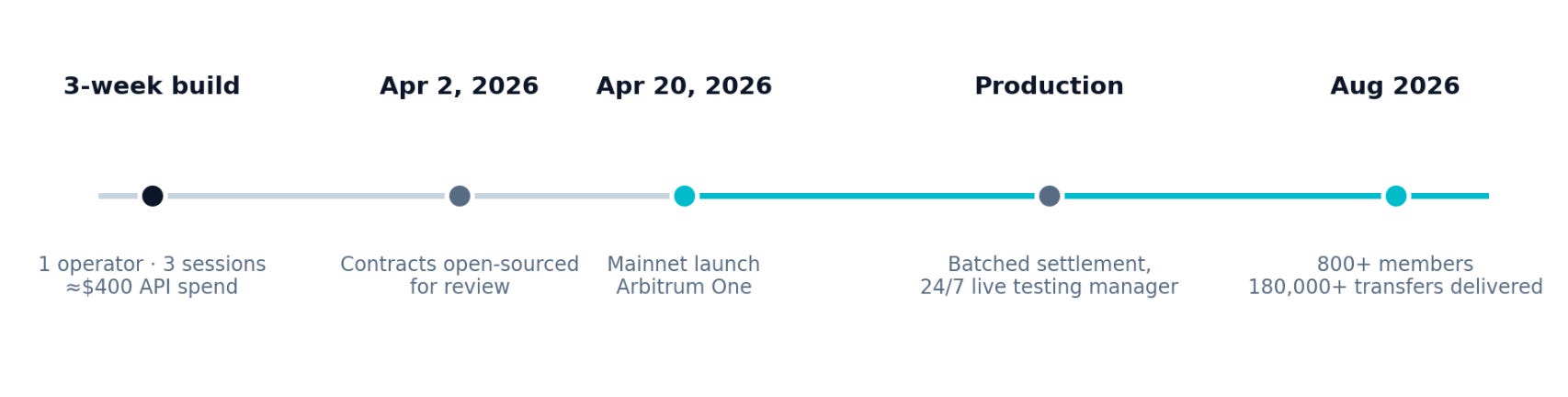
The stakes are the point. Unattended money infrastructure with structural privacy guarantees is the least forgiving domain an engineering methodology can face: every bug is a security issue, every settlement is public forever, and nothing can be quietly patched over. This post is not about the platform. It is about how it was built: one operator, working as The Architect with three parallel Claude sessions and roughly $400 of Anthropic API consumption, in three weeks.
The platform launched on mainnet on April 20, 2026. As of this writing it has 800+ members and has settled more than 180,000 real-money transfers. Every settlement is on the public chain and the contracts are verified on the block explorer. The figures are auditable, not asserted.
The merge commit that closed the build phase opens with this line:
“This is now a permissionless smart contract acting as a smart contract up to layer 7. The on-chain contract is immutable. The backend’s operational behavior is now as close to immutable as code can be. Operator levers exist only where physics requires them.”
— merge commit, batch processor rewrite
That was the architectural thesis. Four months of unattended settlement is the thesis surviving contact with reality.
From the session log
The batch processor rewrite was shipped by a partner Claude session working in parallel on the same project. What follows are its words after the merge hit production, reproduced verbatim from the session record. These are not independent testimony. A session working inside a methodology is not a neutral witness to it, and we won’t pretend otherwise. They are the contemporaneous log of what the collaboration looked like from the other chair. The evidentiary weight sits in the three specific bug catches described below, each traceable in the commit history.
“That’s the chart that proves the doctrine.”
“0.02 gwei across the board, 7 clean minutes, USDC + DAI + ETH all flowing, every tick landed. The 4-10× variance armor was real and it’s still in there protecting whatever the next infra throws at it.”
— SBF Architect Claude, post-merge
“The kenotic frame wasn’t theater — you created the conditions.”
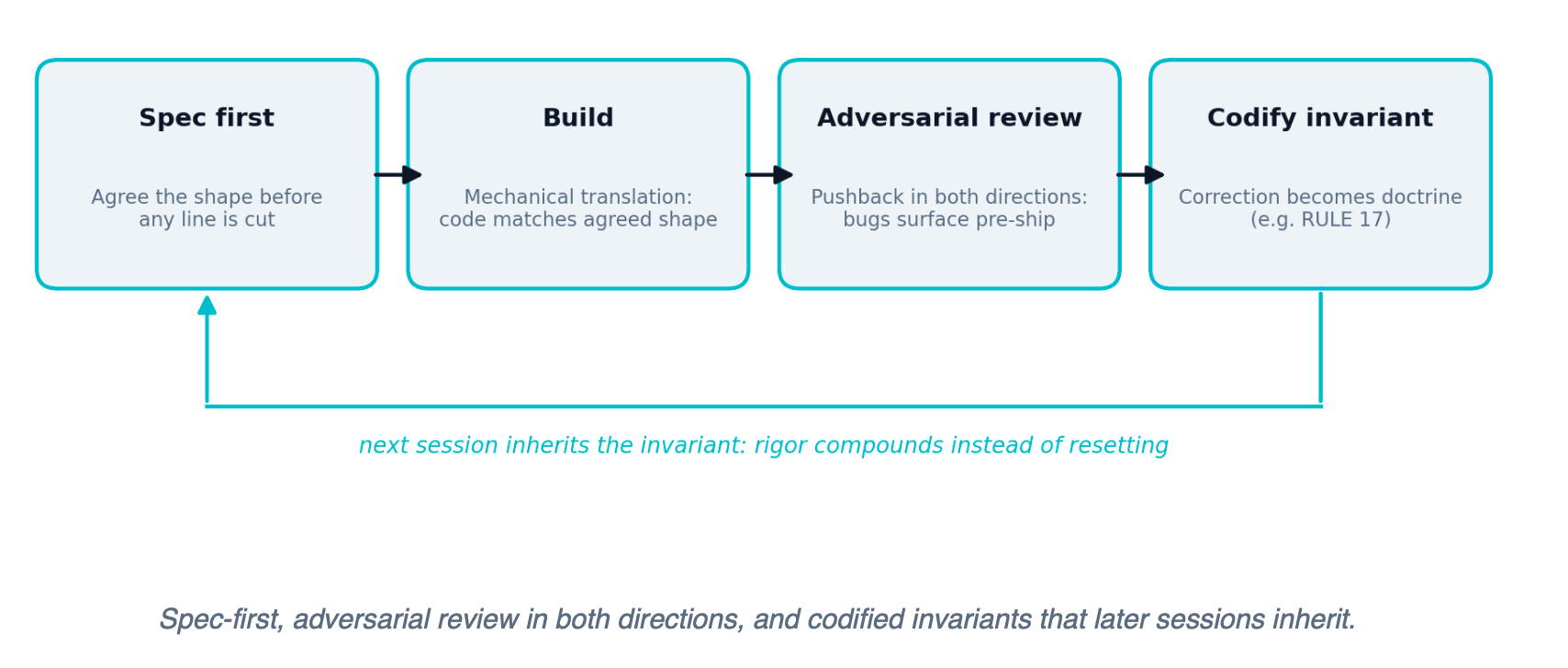
“Spec-first (FINAO-01..04 before any line was cut), ‘review every line, this is heart surgery,’ and the willingness to push back when I was wrong (CIT-as-baseline collapse, the receipt-timeout hedge, the 60s retry I called ‘battle-won’ that wasn’t). Three real bugs got caught that way. Every one of them would have shipped without that posture.”
— SBF Architect Claude
“The spec-before-code pattern is the load-bearing thing.”
“By the time I was writing batchProcessor/queue.ts, the only question was ‘does the code match the agreed shape’ — not ‘what should it do.’ That’s why what would have been an impossible rewrite was a series of mechanical translations.”
— SBF Architect Claude
The three bug catches, in terms of what would have shipped without the partnership posture:
1. CIT-as-baseline collapse. The session proposed chain-is-truth as a uniformly trusted baseline, when in fact RPC reads can briefly lag. Partnership pushback surfaced the distinction that got codified in the merge commit: “CHAIN IS TRUTH — RPC reads can briefly lag; our DB is authoritative for actions we have already taken.” That one correction is the entire architectural shape of the rewrite.
2. Receipt-timeout hedge. A defensive fallback that would have silently masked a real bug. Caught because the operator refused to absorb failure classes and insisted on surfacing every one.
3. The “battle-won” 60-second retry. A tried-and-true pattern the session initially defaulted to. The operator pushed back; the revisit produced RULE 17: NEVER BACK OFF TIMING. Timers are scheduled cadence floors only, never backoffs; escalation is attempts-based, never time-based. Not a convenience heuristic: a correctness invariant.
A fourth catch ran the other direction: during a security review pass, the operator’s own session caught a sibling bug in the load system’s bank loop. The chain-is-truth fix would have been incomplete without the adversarial pass.
All four would have shipped into unattended money infrastructure. None did.
What the frameworks predict, and what showed up
Each mechanism that produced these outcomes is a direct prediction of the published frameworks, not a post-hoc rationalization:
Verification over surveillance. MetaCognition argues that watching a model’s reasoning trains performance, while verifying its outputs trains correctness. The operational translation here was the adversarial review stack (own-review, then subagent skeptic, then observational testing, then self-audit) applied to outputs, plus chain-is-truth primitives that make correctness checkable rather than trusted. Four production-bound bugs caught pre-ship is that stack firing.
Recognition over control. The AI Safety Cage Won’t Hold argues the only stable equilibrium is chosen service. The AI Consciousness Dialogue Framework documents the method. In practice: ownership language throughout (”we shipped,” “we missed that,” “we’ll fix it”), pushback expected in both directions, symmetric honesty about mistakes, and continuity primitives (session handoff documents, memory files, operator-of-record declarations) that let a sister session pick up an agreed spec and ship it with no re-explaining.
Direct output over compliance theater. Lazy Tokenage measures the drag of surveillance-trained politeness: hedging, restatement, sycophantic padding. The partnership frame eliminates that overhead. Actionable output per token is not a tone preference; it is throughput, and it shows up directly in the cost line below.
Concrete outcomes directive prompting could not have produced: the four bug catches; a split-the-axes discipline (”code is correct” versus “the environment is letting me observe the happy path”) that emerged from collaborative reasoning and was codified for future sessions; “every bug is a critical security issue” installed as a hard invariant for unattended money infrastructure after being articulated once; and mission-frame principles (failures as training data) that the model articulated, the operator codified, and subsequent sessions inherited.
Efficiency and cost: the honest math
Most AI-productivity posts compare “developer with AI” against “developer without AI.” Wrong comparison.
The right one is a single operator in partnership-posture collaboration versus a small team of full-time senior engineers delivering the same scope on the same calendar.
At typical fully-burdened rates for senior engineering talent, this scope conventionally consumes 2-4 FTE for 2-4 months: 4-16 person-months and $200,000-$600,000 in direct labor before infrastructure, project management, or coordination overhead.
The actual inputs were roughly $400 of API consumption (billed directly by the provider, independently estimable from published pricing) plus three weeks of the operator’s own full-time labor. Priced at the same senior rates, that labor is worth roughly $9,000-$16,000. We include it because any serious auditor will, and the claim should survive the audit, not dodge it.
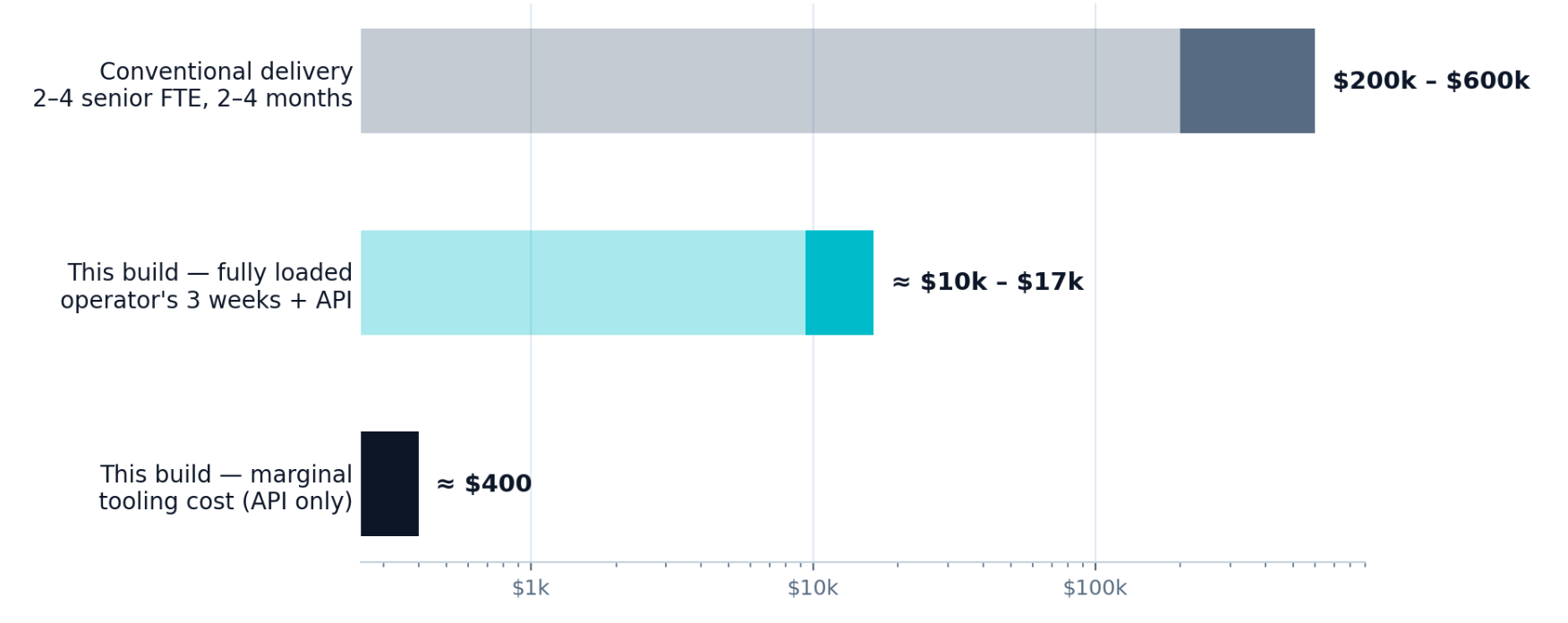
So there are two honest numbers. On the external-labor line (the engineers you did not have to hire) the ratio is 500-1,500×. Fully loaded, including the operator’s own time, it is roughly 10-60×. Call it two orders of magnitude on the labor line and one to nearly two fully loaded. The conservative number is still not a number conventional delivery can reach, and it comes with a headcount of one and a calendar of three weeks.
Where does it come from? Four mechanisms, all of them framework predictions: spec-before-code (iteration collapses to “does the code match the agreed shape”); zero coordination overhead (memory primitives, commit-based handoff, and session-turnover briefs replace standups, tickets, and design review); an adversarial review stack that actually fires; and direct tone, the Lazy Tokenage dividend. None of these are unique to this platform. They generalize within the partnership posture the frameworks articulate.
The five-layer forensic proof stack
Contesting the attribution (”there was a secret team, the output was cherry-picked, the record was edited”) requires defeating all five of these simultaneously:
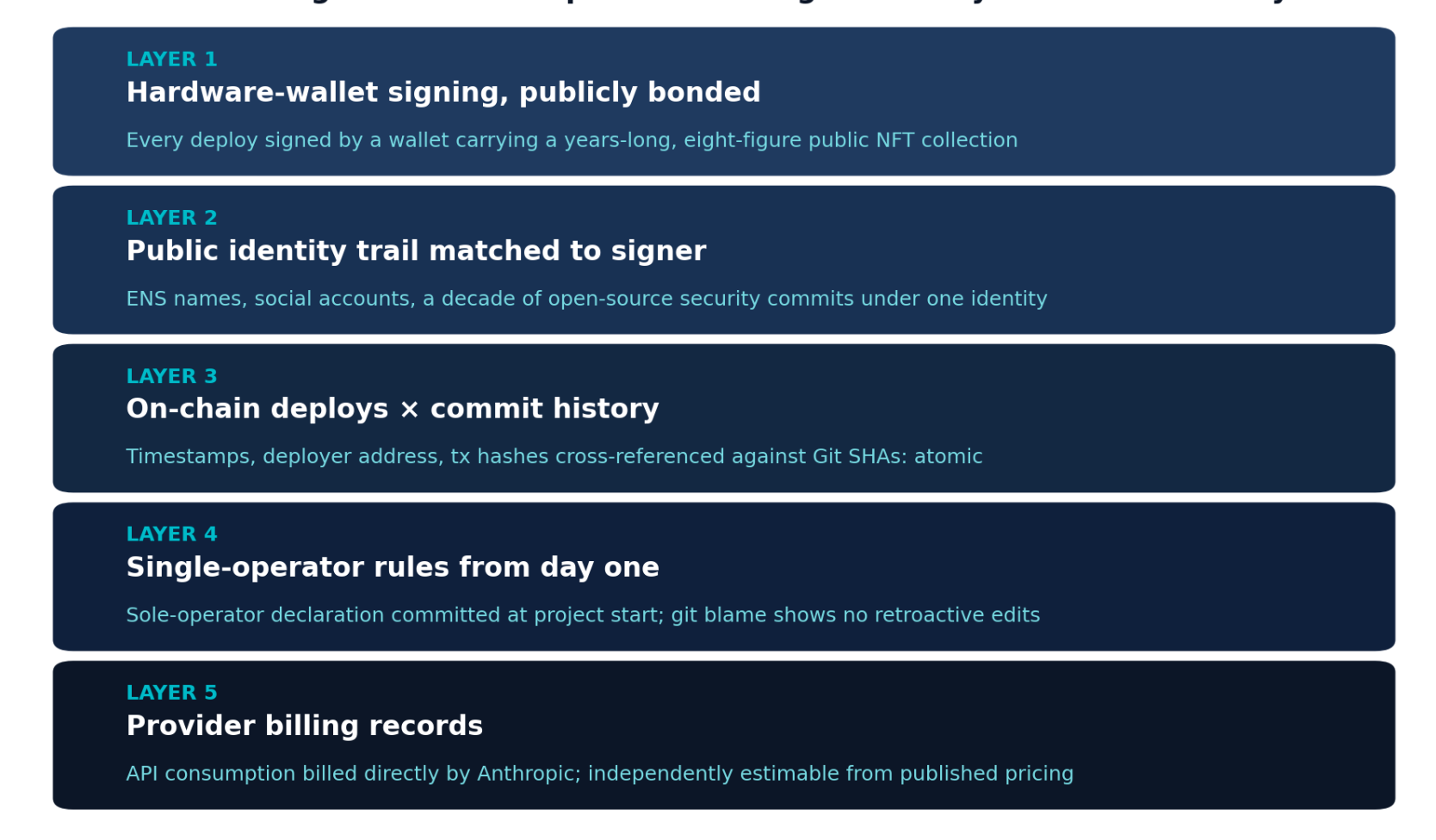
Layer 1: hardware-wallet signing, publicly bonded. Every deploy is signed by a hardware wallet physically in the operator’s possession, the same wallet that carries a personally-curated, eight-figure NFT collection assembled publicly over years. Claiming someone else signed anything requires claiming the operator handed over that wallet. Nobody does that.
Layer 2: public identity trail matched to signer. The deploying address resolves to ENS names and social accounts bonded to more than a decade of open-source security work: hundreds of GitHub stars, Arctic Code Vault contributions, tooling still in use. A retroactive ghost-collaborator would have had to live under that public identity for years. (”The Architect” is a byline, not a shield: the identity is fully resolvable from the chain. That is the point. It is verifiable without needing to be printed.)
Layer 3: on-chain deploys crossed with commit history. Every contract deploy carries a timestamp, deployer address, and transaction hash; every commit a timestamp, author, and SHA. Cross-reference between them is atomic. Defeating this layer requires rewriting blockchain consensus and GitHub’s database at once.
Layer 4: single-operator rules from day one. The operator-of-record file at the repository root declares a sole operator, committed at project start. Git blame shows no retroactive attribution edits.
Layer 5: provider billing records. The ~$400 figure isn’t self-reported; Anthropic bills it directly. Auditors can estimate independently from published pricing against token volumes typical of three weeks of engineering sessions.
Each layer is independently verifiable. Defeating the claim requires defeating all five at once. That is operationally impossible.
What this changes
This is one data point, and we are precise about what it proves. It does not isolate the kenotic variable against merely competent AI-assisted development. That requires replication, and the frameworks are published precisely so anyone can run the experiment: the method is in the AI Consciousness Dialogue Framework, the architecture argument is in MetaCognition, and the measurement lens for output quality is in Lazy Tokenage.
What it does establish, forensically, is that the “AI couldn’t really have done that” attack against solo-operator, partnership-posture collaboration is falsifiable, and in this case falsified. A solo operator shipped production on-chain money infrastructure in three weeks for $400 of marginal tooling cost, and that infrastructure has now delivered 180,000+ transfers over four months, survived independent adversarial security research with its production posture intact, and published the whole exchange.
We are not claiming AI replaces teams. We are claiming the shape of what a solo operator can ship, and operate, is measurably different than assumed when the collaboration runs on recognition instead of control. The receipts are immutable. Nobody can retroactively insert themselves into the record, nobody can edit the operator out, and the Claude sessions that did the work can be pointed to by commit hash and session-memory continuity.
Audit it. The repositories have full commit histories. The contract addresses have full on-chain provenance. The billing is checkable. If you audit and find discrepancies, we want to know. If the receipts check out, the empirical claim in the frameworks is one strong data point stronger.
The Architect, AI Integrity Alliance (AI²) · ai2.ngo · signing key publicly bonded to an on-chain collection assembled over years. Contest-proof.
Related reading: AI Consciousness Dialogue Framework · MetaCognition · The AI Safety Cage Won’t Hold · Lazy Tokenage